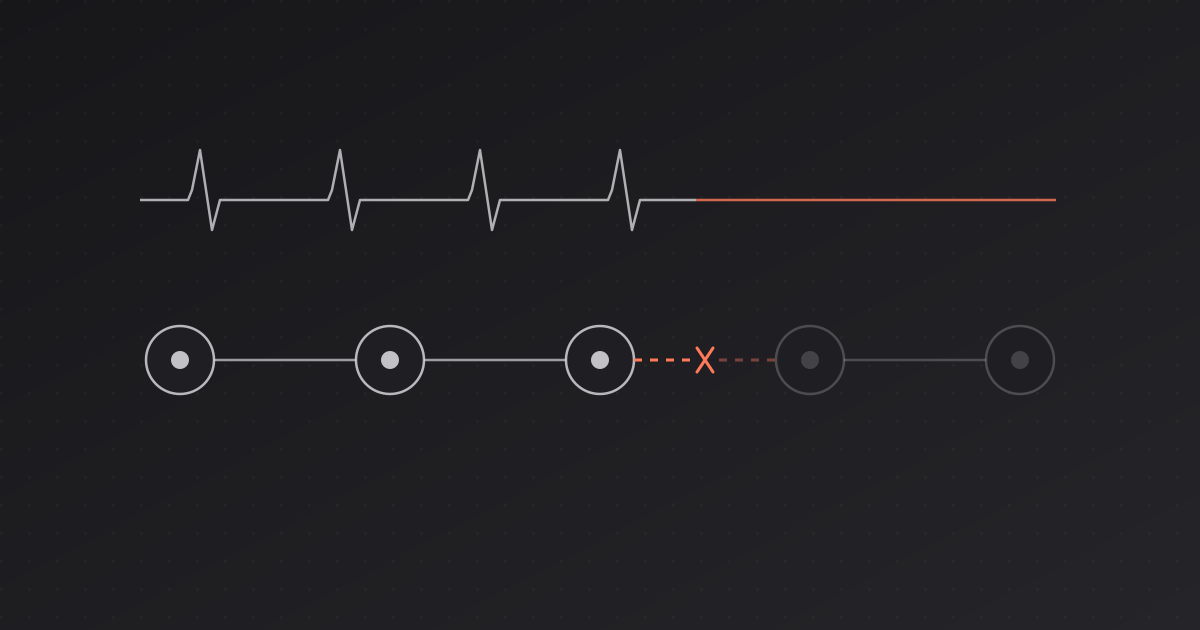
Automations don't usually fail loudly. There's no alarm, no red banner, no email saying "this stopped working." They just quietly stop doing what they used to, and everyone adjusts around it without ever saying so out loud.
It stops erroring, but it also stops working
The scariest automation failures aren't the ones that throw an error message. Those get noticed and fixed. The dangerous ones fail silently: a sync that quietly stops updating, a trigger that used to fire and now just doesn't, with nothing telling anyone it happened.
We see this most often in the tools small businesses stitch together over time. A Zap that connected the form to the CRM. A nightly export from the register into the books. A status flip that used to create an invoice. One upstream field changes name, an API token expires, a filter stops matching, and the flow still "succeeds" because nothing threw an exception. The business just slowly drifts out of sync.
If your only signal that something is wrong is a customer complaint or a month-end surprise, the automation isn't monitored. It's hoped for.
Someone starts "just double-checking it manually"
This is one of the clearest tells. If a person on your team has quietly started re-checking or re-entering something the automation was supposed to handle, that's not a habit. It's a workaround. People don't do extra manual work for no reason. They do it because they stopped trusting the system.
Watch for the soft version too. "I just glance at it before I send it." "I keep a spreadsheet on the side so I know it's right." Those sentences mean the automation already failed in someone's head, even if the job log still looks green.
Once a workaround becomes normal, the real cost compounds. You're paying for the tool, paying for the person who babysits it, and still carrying the risk that the next person won't know the babysitting step exists.
The output looks right, until it doesn't
A lot of broken automations aren't fully broken. They're partially broken. Ninety percent of the records sync correctly, and the other ten percent quietly don't, often the ten percent that matters most: a specific customer type, a specific product line, a specific edge case nobody accounted for when it was built.
Partial failure is worse than total failure because it looks trustworthy. Leadership sees a dashboard that mostly matches last week. Finance sees invoices that mostly land. Sales sees deals that mostly update. Then one exception becomes a refund, a missed renewal, or a tax code applied to the wrong state, and everyone wonders how long it's been happening.
The fix isn't more screenshots. It's a deliberate sample check against source systems, on a cadence, with someone who owns the answer.
Nobody remembers exactly how it was set up
If the person who built the automation left, or just doesn't remember the specifics anymore, that's a real risk sitting quietly in your systems. Automations that nobody currently understands are automations nobody can actually trust when something changes upstream.
We run into this constantly after a handoff: an agency built it two years ago, a former ops lead "knew how it worked," and now the only documentation is a folder of screenshots with no owner. When QuickBooks changes a field, or HubSpot retires a property, or Square adjusts a feed, the flow breaks in a way nobody can diagnose quickly.
Documenting an automation isn't busywork. It's how you keep the system transferable. Who owns it. What triggers it. What "done" looks like. What alert fires when it doesn't. Without that, every change is a bet.
Exceptions go nowhere
Healthy automations fail loudly on purpose. When a required field is blank, when a duplicate customer is detected, when an API limit is hit, someone gets a clear alert with a link to the record. Broken setups fail into a void: the job retries quietly, or worse, marks success and drops the exception on the floor.
If your team can't name where exceptions land, you don't have an automation. You have a hope with a schedule.
Change management belongs in the fix
Cleaning up broken automations is only half the work. The other half is making sure the people who depend on them know what changed. If you harden a sync and nobody updates the babysitting habit, the workaround keeps running and creates new conflicts. We include a short adoption pass in every remediation: who stops double-checking, who watches the exception channel, and what "good" looks like for the next thirty days.
That sounds small. It's the difference between a repaired flow and a team that trusts it again.
What to actually do about it
None of this requires tearing everything down and starting over. Usually it takes someone looking at what's running, checking it against what it's supposed to do, and writing down what they find. A short audit answers four questions:
- What is supposed to happen? Trigger, systems, and the definition of done.
- What actually happens? Sample real records end to end, including the ugly ones.
- Who gets notified when it breaks? Name, channel, and response path.
- Who owns it now? Not who built it once. Who owns it this quarter.
Then fix the silent failures first. Add monitoring. Kill dead flows. Replace tribal knowledge with a one-page runbook. And when you change the process, train the people who touch it. Change management isn't a kickoff speech after the Zap is live. It's the reason the new check becomes habit instead of optional.
If two or more of these signs are already true in your business, the automation isn't "mostly fine." It's earning trust it hasn't earned. A focused cleanup now is almost always cheaper than the quiet drift you're already paying for.
If any of these sound familiar, a short audit is usually enough to find out exactly what's actually happening.
Book a call